Text Widget

Blog Archive

Featured Articles

Decoration

All Stories
Showing posts with label Politics. Show all posts

Thursday, October 30, 2014

Even Mahatma Gandhi Seems Incomplete Without Sardar Patel, Says PM Narendra Modi


NEW DELHI:  Prime Minister Narendra Modi was at the centre of a massive commemoration today of  the birth anniversary Sardar Vallabhbhai Patel, India's first Home Minister, who belonged, like Mr Modi, to Gujarat.   

"Without Sardar Patel, even Mahatma Gandhi seems incomplete. It was a unique partnership that strengthened the struggle for independence," the Prime Minister said after he placed flowers on a statue of Sardar Vallabhbhai Patel in Delhi. 

Dressed in a white kurta pyjama with a red shawl, Mr Modi then walked briskly down one of Delhi's main roads, flagging off a countrywide "Run for Unity" with thousands of participants by his side.

Since taking office, Mr Modi's government has said Sardar Patel's birth anniversary will be celebrated ever year as Rashtriya Ekta Diwas or "National Unity Day."  

Today is also the 30th death anniversary of former Prime Minister Indira Gandhi, whose assassination by her Sikh bodyguards in 1984 triggered riots in which thousands of Sikhs were killed in the capital.   

In a tweet, Mr Modi said, "I join my fellow countrymen and women in remembering former PM (Smt) Indira Gandhi on her Punya Tithi (death anniversary)."  Referring to the communal violence that followed her death, he said, "It was a dagger into the heart of thousands of years of country's heritage and culture."

The PM and his party, the BJP, have accused the Congress of ignoring the legacy of Sardar Patel as a founding father of the country and promoting only the Nehru-Gandhi dynasty.  Stung, the Congress has said that the PM should remember and acknowledge that the Sardar was a Congressman.

Mr Modi's government has said it will provide $33 million dollars or about Rs.3000 crore towards the construction of a massive statute in Gujarat of Sardar Patel, intended to be twice as tall as that of the Statue of Liberty
Thursday, October 30, 2014 - By Unknown 0

The State Department is too top-heavy with Obama political picks, says foreign service group


U.S. President Barack Obama (L) shakes hands with Deputy Secretary of State William Burns at the Diplomatic Corps holiday reception at the State Department in Washington December 19, 2012. (Yuri Gripas/REUTERS)
The State Department is too top-heavy with Obama political picks, says foreign service group
Thursday, October 30, 2014 - By Unknown 0

Will Christie's 'sit down and shut up' style work outside New Jersey?


FILE - This July 17, 2014, file photo shows New Jersey Gov. Chris Christie greeting Iowans after speaking at a fundraiser for Iowa Gov. Terry Branstad in Davenport, Iowa. Christie is headlining Branstad's birthday bash in Clive, Iowa, Saturday Oct. 25, 2014, one of the biggest events on the state's political calendar, cementing his status as Branstad's favored 2016 candidate and giving him his biggest platform yet to appeal to activists in the state. (Charlie Neibergall, File/AP Photo)
Will Christie's 'sit down and shut up' style work outside New Jersey?
Thursday, October 30, 2014 - By Unknown 0

Death penalty sought for trooper ambush suspect


Authorities say they have captured a man accused of killing one Pennsylvania State trooper and seriously injuring another during an ambush outside police barracks. (AP)
Manhunt for gunman of a state police barracks ambush
A survivalist accused of ambushing two Pennsylvania state troopers, leaving one dead and seriously injuring the other, was captured on Thursday, ending a seven-week manhunt for him, authorities said.
State police confirmed Eric Frein was taken into custody but released no details.
A federal law enforcement official in Washington said Frein was armed when he was captured by U.S. marshals on Thursday. The official wasn't authorized to discuss the circumstances of Frein's arrest and spoke to The Associated Press anonymously. (AP)

Find more news related pictures on our photo galleries pageand follow us on Tumblr
Thursday, October 30, 2014 - By Unknown 0

Burkina Faso parliament set ablaze

Protesters angry at plans to allow Burkina Faso's President Blaise Compaore to extend his 27-year-rule have set fire to parliament.
Burkina Faso's parliament on fire (30 October 2014)
Correspondents say the city hall and ruling party headquarters are also in flames.
A huge crowd is surging towards the presidential palace and the main airport has been shut.
MPs have suspended a vote on changing the constitution to allow Mr Compaore to stand for re-election next year.
Five people have been killed in the protests, among the most serious against Mr Compaore's rule, reports BBC Afrique's Yacouba Ouedraogo from the capital.
The military fired live bullets as protesters stormed parliament, our correspondent says.
Journalists are now gathered outside the defence ministry awaiting a statement from the military, he says.
Map showing Burkina Faso
Witnesses say dozens of soldiers have joined the protests, including a former defence minister, Gen Kouame Lougue.
The main opposition leader, Zephirin Diabre, has called on the military to side with "the people".
TV off air
Mr Compaore's whereabouts are unknown, but he has appealed for calm via Twitter.
He first took power in a coup in 1987, and has won four disputed elections since then.
line
At the scene: Joost Laane, speaking to BBC Focus on Africa
I am in an area where many MPs live and I have seen two of their homes set ablaze and smoke coming out of another two or three homes. Hotel Azalai, one of the main hotels in the city, is also on fire.
Two helicopters flew over my house - the president's and a normal helicopter. I cannot confirm whether the president was in one of them.
No-one knows what is going to happen next. It is chaotic and tense. We hear sporadic gunfire.
There is no TV anymore. So we are depending on internet access and phone calls. The 3G network and the texting system are blocked.
line
The opposition has called for a campaign of civil disobedience to demand that he steps down in elections next year.
"October 30 is Burkina Faso's black spring, like the Arab Spring," opposition activist Emile Pargui Pare told AFP news agency.
A man stands in front of a burning car, near the Burkina Faso's Parliament where demonstrators set fire to parked cars - 30 October 2014, Ouagadougou, Burkina FasoCars were also set ablaze near parliament
Men shout slogans in front of burning cars, near the Burkina Faso's parliament - 30 October 2014,  Ouagadougou, Burkina FasoThe protesters do not want Mr Compaore to change the constitution to extend his rule
Burkina Faso troops try to disperse protesters in Ouagadougou on 30 October 2014 The defence forces have been trying to disperse the protesters
State television went off air after protesters stormed the building housing it and ransacked it, Reuters quotes a witness as saying.
About 1,500 people breached the security cordon at parliament, according to AFP.
Protesters were setting fire to documents and stealing computer equipment and cars outside the building were also set on fire, the agency says.
line
Blaise Compaore
  • Served under President Thomas Sankara as minister of state to the presidency
  • Took power after Sankara was killed in mysterious circumstances by a group of soldiers in 1987
  • First elected president in 1991 and again in 1998
  • A new constitution in 2000 limited presidents to two terms in office, and limited terms to five years
  • Won two further terms
  • Protests at attempts to amend the term limits began a year ago, fuelled by the high cost of living
line
A massive crowd has also converged on the main square in Ouagadougou and is marching towards the presidential palace, which is about 5km (three miles) away, our reporter says.
A government helicopter flying overhead was firing tear gas at them, Reuters reports.
There are also reports of protests in the south-western city of Bobo Dioulasso.
The government has been forced to suspend Thursday's parliamentary vote on a constitutional amendment that would have lifted the limit on presidential terms so that Mr Compaore could run for office again in 2015.
It is not clear whether the government intends to hold the vote at a later stage, correspondents say.
Mr Compaore is a staunch ally of the US and France, which uses Burkina Faso as a base for military operations against militant Islamists in the Sahel region.
Both France and the European Union (EU) have called on him to scrap the proposed constitutional amendment.
The EU said it could jeopardise Burkina Faso's stability. The US has also raised concern about the proposed amendment.

Thursday, October 30, 2014 - By Unknown 0

Saturday, September 27, 2014

Jayalalitha --Jayalalithaa will have to step down as CM for second time


woman A supporter of AIADMK supremo and Tamil Nadu CM Jayalalitha cries as the latter leaves her Poes Garden residence to appear before a Bangalore special court in connection with a disproportionate assets case, in Chennai on Saturday. (Source: PTI)
Written by Johnson T A | Bangalore | Posted: September 27, 2014 3:20 pm | Updated: September 27, 2014 5:57 pm
The 66-year-old Jayalalithaa has been charged under provisions of the Prevention of Corruption Act 1988 in the disproportionate assets case along with three others.
In a previous instance in September 2001 during her second term in power Jayalalitha had been forced to step down as Chief Minister after she was convicted to five years of imprisonment in the Tansi land scam case.
The Supreme Court had ruled that she cannot be Chief Minister when convicted in a criminal case. Jayalalithaa however returned as Chief Minister five months later in March 2002 after being acquitted of the charges in the Tansi case.
The special judge, in Rs 66.65 crore Disproportionate Assets case, John Michael Cunha was orginally scheduled to pronounce judgment in the Jayalalitha case on September 20 but the case was posted to September 27 after concerns were raised about security. The case was shifted to a court attached to the Bangalore Central Prison located on the outskirts of the city.
jayalalithaaptim
Jayalalitha and three associates – her former close friend V K Sasikala, Sasikala’s nephew V N Sudhakaran and sister-in-law J Illavarasi have been accused of acquiring Rs 66.65 crore worth of assets by corrupt means between 1991-96 during Jayalalithaa’s first tenure as Chief Minister.
The Disproportionate Assets case was registered in 1997 and investigations were carried out under the DMK regime which deposed Jayalalitha from power in April 1996. The case was transferred to Karnataka by the Supreme Court in 2003 on a plea by a DMK official K Anbazhagan alleging subversion of the trial by Jayalalitha when she returned as Tamil Nadu chief minister in May 2001.

modiwithjaya480

The case had been crippled by delays on various counts including changes of the Special Public Prosecutor appointed to carry out the trial. The High Court appointed SPP in the case, B V Acharya, had quit in August 2012 after accusing the then BJP government in Karnataka of seeking his ouster to further political ties with Jayalalithaa’s AIADMK party.
A second public prosecutor appointed in the case, Bhawani Singh, was threatened with a fine of Rs 60,000 per day by the special court last year for seeking frequent adjournments and delaying the trial. The court in its judgment is expected to make observations about the conduct of the accused and the prosecution in causing delays in the trial.
The special court in the course of the trial took into its custody key evidence in the case in the form of 23 kg of gold, 1165 kg of silver and 91 wrist watches that had been seized from Jayalalithaa and the co-accused by the Tamil Nadu Directorate of Vigilance in Chennai in 1997. continued…
- See more at: http://indianexpress.com/article/india/india-others/background-jayalalithaa-da-case/#sthash.qGqvhEKY.dpuf
Saturday, September 27, 2014 - By Unknown 0

Oklahoma beheading

Oklahoma beheading: FBI probing suspect's recent conversion to Islam


                                                             WATCH IN YOU TUBE>>


FBI officials are investigating a beheading at an Oklahoma food distribution center after co-workers said the suspect tried to convert them to Islam after his own recent conversion.
The suspect, Alton Nolen, 30, was recently fired from Vaughan Foods in Moore prior to Thursday’s attack. Moore Police Department Sgt. Jeremy Lewis toldKFOR that Nolen drove to the front of the business and struck a vehicle before walking inside. He then attacked Colleen Hufford, 54, stabbing her several times before severing her head. He also stabbed another woman, 43-year-old Traci Johnson, at the plant.
Lewis said Mark Vaughan, the company’s chief operating officer and a reserve county deputy, shot Nolen as he was stabbing Johnson, who remains hospitalized in stable condition Friday.
“He’s a hero in this situation,” Lewis told the station. “It could have gotten a lot worse.”
Nolen was apparently attacking employees at random, authorities said. The motive for the attack is unclear, but FBI officials confirmed to Fox News that they were assisting the Moore Police Department in investigating Nolen's background and whether his recent conversion to Islam was somehow linked to the crime.
The police department issued a statement saying, "After conducting interviews with Nolen's co-workers, information was obtained that he recently started trying to convert several employees to the Muslim religion. Due to the manner of death and the initial statements of co-workers and other initial information, the Moore Police Department requested the assistance of the FBI in conducting a background investigation on Nolan."
Nolen, according to state corrections records, was convicted in January 2011 of multiple felony drug offenses, assault and battery on a police officer and escape from detention. He was released from prison in March 2013.
Saad Mohammad, a spokesman for the Islamic Society of Greater Oklahoma City, told NewsOK.com that leaders of the society’s mosque are taking security precautions to protect Muslims who gather there from any potential retaliatory violence.
Mohammad said any anti-Muslim sentiments local residents might have could be heightened due to the beheadings and violence overseas by Islamic State militants.
“They have this ISIS thing on their minds and now this guy has brought it to America,” Mohammad told the website.
Lewis said he does not yet know what charges will be filed against Nolen, adding that police are waiting until he's conscious to arrest him. Authorities said he had no prior connection to either woman.
Moore Police Department officials have released 911 calls from the incident,OKCFox.com reports. During the recording, a caller tells an operator that a person is attacking someone in the building. Several gunshots can be heard in the background at the end of the call.
A Vaughan spokeswoman said the company was "shocked and deeply saddened" by the attack.
The Associated Press contributed to this report.


Related searches: beheading in oklahoma, colleen hufford, oklahoma, beheading
Saturday, September 27, 2014 - By Unknown 0

Friday, February 21, 2014

Obama's ambitious trade agenda hits Asian resistance

By Linda Sieg and Rachel Armstrong
TOKYO/SINGAPORE (Reuters) - America's ambitious trade agenda is running into fierce resistance in Asia, but negotiators say a draft Pacific free-trade deal that papers over some differences may be ready by the time U.S. President Barack Obama visits the region in April.
A central element of Obama's strategic shift towards Asia, the Trans-Pacific Partnership (TPP) could accelerate global economic growth, boost U.S. exports and level the playing field between emerging and rich nations in one of the world's biggest trade pacts, covering about one-third of global trade.
The White House had hoped to complete the deal, which aims to cut tariffs and set common standards on other issues, last year. But that didn't happen and negotiators fly into Singapore on Saturday for three days of talks on the 12-country pact.
Significant challenges remain, including U.S. frustrations over Japanese protection of sensitive agricultural products, such as rice, and U.S. automakers' fears of increased competition from Japan.
At the start of U.S.-Japan working-level talks this week, a Japanese cabinet minister said Tokyo could make concessions on tariffs on some sensitive farm products, but negotiators said big gaps remained between the two sides.
Japanese Prime Minister Shinzo Abe, who took office 14 months ago pledging to revive the world's third-largest economy, has made the trade pact a key part of a growth strategy known as the "Third Arrow" of his "Abenomics" recipe. The other two "Arrows" are hyper-easy monetary policy and fiscal spending.
"Abe has told international society he would go ahead with TPP so he has to make progress," said a Japanese official familiar with the matter. "It is not so easy to accept failure."
While the United States and Japan agree on many issues, they remain at odds over politically sensitive sectors for both countries. Washington has been pressing Tokyo to scrap all tariffs in the five categories of rice, beef and pork, dairy products, wheat and sugar. These include 586 product lines.
Japan wants the United States to set a timeline for scrapping tariffs of 2.5 percent on imports of passenger cars and 25 percent on light trucks.
"The negotiations present extremely high hurdles for Japan, and considerable gaps remain between Japan and the U.S," Economy minister Akira Amari, in charge of Japan's delegation, told reporters on Friday before flying to Singapore. But he said Abe had told him to do his best to reach a deal.
An agreement between the United States and Japan would set the tone for the other countries engaged in the TPP: Australia, Brunei, Chile, Canada, Malaysia, Mexico, New Zealand, Peru, Singapore and Vietnam.
"LITMUS TEST"
The stakes are high for Obama as well. Internationally, he needs to make good on TPP as a key element of his promised "rebalance" of economic and security policy to Asia at a time when many in the region question his commitment to the region.
His planned visit to Asia in April is seen by some experts and negotiators as a target for a preliminary draft deal for TPP that would send a signal Washington wants to add economic substance to a pivot strategy otherwise largely about shifting some military forces to Asia to counter a rising China.
"If the TPP is not realized, it will deal a major blow to the U.S. rebalancing strategy," said Bonnie Glaser, senior associate at the Center for Strategic and International Studies and a consultant for the U.S. government on East Asia.
"A lot of countries are seeing this as a litmus test."
Two New Zealand officials with knowledge of negotiations say an in-principle deal might be unveiled during Obama's April visit but that it would paper over significant differences, leaving those to later.
New Zealand's negotiators, one official said, are adopting a "more realistic" view of the TPP process after Obama faced resistance within his Democratic Party on a proposal to give the White House power to fast-track trade deals - so-called Trade Promotion Authority (TPA) - which would deny U.S. lawmakers the opportunity to amend the pact.
"The worry among the other countries is: 'What if everything we've negotiated on is pointless and we have to re-negotiate it to get it past Congress'?" said Deborah Elms, who has regular talks with TPP negotiators as head of the Temasek Foundation Centre for Trade and Negotiations, a Singapore think tank.
Others said such concerns were overdone. Former White House international economic adviser Matthew Goodman said talk of countries unwilling to seal a deal because Obama lacks fast-track approval was "more of a negotiating tactic" and once a pact was agreed, getting it through Congress would get easier.
Illustrating the challenges, some countries such as Malaysia have little chance of securing a deal due to intense domestic opposition and could ultimately drop out of the pact.

Obama departs the White House in Washington
Malaysia's government has faced a debilitating backlash over the TPP both from the political opposition and from powerful traditionalists within the ruling party.
Malaysian Trade Minister Mustapa Mohamed listed at least seven areas where negotiators still have significant concerns, including intellectual property, state-owned enterprises, labor union rights and the environment.
"It's just a matter of time that these issues will have to be dealt with. The issue is when," he said on Thursday. "In a way if you are not part of this, we may miss the boat."
Even if negotiators reach a draft agreement, passage of TPP for many countries could drag on for more than a year. But the pact is at a pivotal juncture.
"I don't know if we are ever going to do this deal or not and if we are going to do it, whether the essential political bits will come together in the next few days, but it has the smell of reaching a moment of truth," said New Zealand Trade Minister Tim Groser.
Some experts worry that a lack of U.S. will to clinch the deal would give China - which is not part of the TPP talks - a chance to fill the vacuum. "The U.S., in particular, we don't think has been as engaged as it might have been," said Bryan Clark, director of trade and international affairs at the Australian Chamber of Commerce and Industry.
China is consolidating its position as the largest trade partner with most Asian countries and its direct investments in the region are surging, albeit from a lower base than Europe, Japan and the United States.
(Additional reporting by Krista Hughes and David Brunnstrom in Washington, Gyles Beckford in Wellington, Matt Siegel in Sydney, and Stuart Grudgings in Kuala Lumpur; Writing by Jason Szep; Editing by Raju Gopalakrishnan)
Friday, February 21, 2014 - By Unknown 0

Deal signed to end Ukraine crisis By Phil Black. Nick Paton Walsh and Michael Pearson, CNN February 21, 2014 -- Updated 1631 GMT (0031 HKT)

re you in Ukraine? Send us your photos and experiences but please stay safe.
Kiev, Ukraine (CNN) -- Ukraine's President and opposition leaders agreed Friday to a deal meant to end the country's political crisis and bloody fighting that has left parts of Kiev a war zone.
President Viktor Yanukovych, opposition leaders and representatives of the European Union signed the deal Friday afternoon after a night of difficult negotiations that stretched well into the day.
"Good compromise for Ukraine. Gives peace a chance. Opens the way to reform and to Europe," Polish Foreign Minister Radoslaw Sikorski said via Twitter before the signing was completed.
A cheer went up from the crowd in Kiev's Independence Square when the agreement was announced. Protesters waved Ukrainian flags under clear skies free of the choking smoke from burning barricades that has characterized recent days.
But it remained to be seen if the deal would be enough to overcome the nation's deep divisions and mistrust on both sides inflamed by the recent violence.

Protesters: 100 dead in Ukraine

Gunfire heard in Kiev, protesters fall

'I am a Ukrainian'

Will the Ukraine truce last?
Ukraine's parliament moved quickly to fulfill the first requirement of the agreement -- passing a law to roll back the country's constitution to an earlier version that limits the President's powers.
The deal calls for further constitutional reform to be completed by September, according to a draft posted on the German Foreign Office's website.
It also requires presidential elections "as soon as the new Constitution is adopted but no later than December 2014."
And protesters are to withdraw from streets and public buildings they've occupied during the crisis and turn in illegal weapons, according to the deal.
Security forces are to "step back from confrontational posture" and use force only to protect public buildings, the agreement says.
A joint investigation into the recent violence will follow. Authorities, opposition representatives and the European Council will be included, according to the deal.
Reaction to the signing from opposition leaders wasn't immediately available.
Earlier, opposition leader and former boxer Vitali Klitschko said protesters must keep the pressure on the government.
"We must do everything to stop the confrontation, and the people who gave illegal orders will be brought to justice," he said.
While developments appeared encouraging, an earlier fragile truce crumbled just a day before amid renewed fighting. Geoffrey Pyatt, U.S. ambassador to Ukraine, called the result Thursday "the most tragic day in the history of Ukraine."
The crisis began in November with anger about Yanukovych's decision to scrap a European Union-oriented trade deal and turn toward Russia.
It escalated this week with fierce fighting that the government says has claimed 77 lives and drew swift rebuke from the West. Protesters put the death toll at about 128.

Photos: Unrest in Ukraine Photos: Unrest in Ukraine

New round of violence erupts in Kiev

Protests are ongoing despite truce

The country has long been divided between historic allegiances to Russia in the east and Europe in the west.
But the disagreement quickly escalated into anger about Yanukovych's rule, including a sweeping, if short-lived, anti-protest law enacted in January.
Russia, which has offered to lend money to cash-strapped Ukraine in a deal worth billions of dollars and lower its gas prices, has put pressure on Yanukovych to crack down on demonstrators.
Western leaders, who have offered Ukraine a more long-term aid package requiring economic modernization, have urged the President to show restraint, allow the opposition more access to government and let the democratic process work out amid deep political differences.
The crisis boiled over Tuesday when security forces waded into the crowd with water cannons, stun grenades, nightsticks and armored personnel carriers. That fighting brought swift condemnation from Western leaders, who accused Ukrainian leaders of a bloody crackdown.
Ukrainian officials, however, blamed protesters for attacking police, invading government buildings and looting hundreds of guns and tens of thousands of rounds of ammunition.
Government officials declared a truce Wednesday, but that cease-fire failed early the next day when fighting broke out again. In Thursday's round of fighting, some protesters appeared to be armed. Men in what appeared to be government uniforms seemed to fight back with automatic weapons and at least one sniper rifle.
In one incident captured by a CNN camera crew, gunfire felled a protest medic trying to treat a man lying on the ground.
One doctor treating protesters said several people had died of targeted wounds that she said appeared to be from sniper shots.
CNN was not able to immediately confirm the claims.
The government acknowledged Thursday that its forces had used firearms, saying it had done so to protect unarmed police officers who were in danger.
The European Union and United States responded to this week's violence with sanctions against Ukrainians deemed responsible for the violence.
Friday, February 21, 2014 - By Unknown 0

Saturday, February 15, 2014

Syria crisis: Last UN try to break Geneva deadlock

Syrian rebels fire a rocket-propelled grenade in Damascus (30 January 2014)  
At least 5,000 people are thought to have died since the first round of Geneva talks started on 22 January


The UN special envoy for Syria will try to break the stalemate between the Syrian government and the opposition at a final session of talks in Geneva.
Lakhdar Brahimi will mediate a last face-to-face meeting with both sides on Saturday morning.
Negotiations reached an impasse as the two delegations traded accusations, with Syrian officials calling the rebels' demands "unrealistic".
The conflict in Syria has claimed more than 100,000 lives since March 2011.
Some 9.5 million people have been forced to flee their homes.
'Unblock the situation' The final talks are due to begin at 11:00 (10:00 GMT).
Mr Brahimi earlier said US and Russian officials had assured him they would try to "unblock the situation".

“Start Quote

Two weeks ago they were at least airing opposing views across a table, and discussing concrete steps like possible ceasefires and prisoner exchanges. Now they can't even agree on an agenda ”
The best outcome the UN can hope for is a commitment to come back to Geneva for further negotiations, the BBC's Imogen Foulkes in Geneva reports.
Many people inside Syria may view such a commitment as meaningless after two rounds of talks achieved little, our correspondent says.
So far, the only agreement in the latest negotiations was to allow civilians to leave and aid to enter the besieged city of Homs.
Otherwise the talks, which started six days ago, have failed to narrow the gap between the government of President Bashar al-Assad and the opposition.
Syria insists on the need to fight what it calls "terrorists", while the rebel delegation stresses the need for a transitional administration to run the country until elections.
Valerie Amos: "Syrians are looking to us to do something"
Syrian officials have said there is no question of replacing President Bashar al-Assad.
Opposition spokesman Louay Safi said the government team had failed to show "any responsiveness".
Correspondents say at least 5,000 people are believed to have died since the first round of the Geneva talks began on 22 January.
US President Barack Obama said he was considering ways of putting more pressure on President Assad, though he did not expect any resolution in the short term.
Speaking in California, where he was meeting Jordan's King Abdullah, he said: "There will be some intermediate steps that we can take applying more pressure to the Assad regime and we are going to be continuing to work with all the parties concerned to try to move forward on a diplomatic solution."
Mr Obama did not disclose what steps he has under consideration.
Earlier, UN humanitarian chief Valerie Amos urged the UN Security Council to act immediately to ensure more humanitarian access in Syria.
The Security Council has been deadlocked over aid deliveries in Syria, where millions have been forced to flee their homes.
Saturday, February 15, 2014 - By Unknown 0

Friday, September 13, 2013

Colorado flooding: Thousands await help; town of Lyons evacuated


BOULDER, Colo. -- As recordbreaking rainfall continued to pound parts of Colorado, officials stepped up evacuations for thousands living in areas endangered by flash flooding as emergency workers moved to aid residents trapped in isolated towns by raging waters.
Colorado FloodingThe National Guard on Friday moved to evacuate people the entire town of Lyons, one of several cut off and without electrical power since flash floods ripped through the state Wednesday night. As much as 9 inches of rain fell within hours in parts of the state, flooding streams, causing mudslides and spilling over earthen dams.
Thousands of people have been ordered to evacuate in cities including Loveland and Longmont in Boulder County. The towns of Lyons, Jamestown and others in the Rocky Mountain foothills have been isolated by flooding and have been without power or telephone service since rain hanging over the region all week intensified late Wednesday and early Thursday.
Sirens blared in Boulder late Thursday and by 11 p.m. about 3,500 people were evacuated from along Boulder Creek where the normally tranquil waterway roared at more than three times its usual rates. The raging waters swirled out of its banks and tore across parks and roads near the heart of the city.
The waters posed two problems, threatening to trap motorists in vehicles while also shutting down roads desperately needed for emergency use. At a morning news conference, Gov. John Hickenlooper warned people not to step into what looked like shallow pools because they usually were deeper than they appeared, often filled with dangerous debris.
“Stay out of your vehicle,” said the governor, who has declared a state of emergency. “Stay home, if possible.”
President Obama signed an emergency declaration Thursday night, allowing federal aid and Federal Emergency Management Agency personnel to work on relief efforts. Hickenlooper, who is planning to tour some of the worst areas, said he was meeting with federal officials later on Friday.
There is no estimate of the damages, but recovery is expected to easily run into the tens of millions of dollars and rebuilding of some roads and bridges will take time, the governor said.
At least three deaths have been confirmed and one person is missing, officials said.
Seventeen people are considered unaccounted for across Boulder County, Liz Donaghey, a spokeswoman for the Boulder County Office of Emergency Management, told the Los Angeles Times. She added that does not necessarily mean they are missing but as of 7 a.m. they could not be reached by phone.
Getting to and from most anywhere in much of the state continued to be not only a headache but also a hazard. Officials estimate between 70 to 100 roadways and highways have been closed in Boulder County alone,  Donaghey said. U.S. 36, the major eastbound artery between Boulder and Denver, saw rising waters on the highway. Cars were pushed to the side where they stood precariously.
The northern section of U.S. 36 is also closed between Lyons and Estes Park, where the  town of Lyons remains mostly cut off. National Guard troops did reach the town with supplies on Thursday night.
As the National Guard continued its relief efforts on Friday in Lyons, the National Weather Service warned of more flash flooding there. Also, the Big Thompson River at Drake was more than 4 feet above its flood stage of 6 feet, according to the service.
Residents of Lyons had been evacuated earlier in the week to a center established in a school. Many of those people were being moved a second time on Thursday night and Friday by the Guard.
 “There's no way out of town. There's no way into town. So, basically, now we're just on an island,” said Jason Stillman, 37, who was forced with his fiancee to evacuate their home in Lyons after a nearby river began to overflow into the street, according to the Associated Press.
To the north, residents along the Big Thompson Canyon in Larimer County were also evacuated. The Big Thompson River flooded in 1976 after about a foot of rain fell in just four hours, killing 144 people.  The town of Jamestown also remains isolated.
Rain started to pick up again on Friday morning in Denver. A dam northwest of the city was among those breached on Thursday and the waters now threaten several neighborhoods in the suburb of Commerce City. The city of Aurora also reporting flooding.
Eldorado Springs, home to about 500 people, was urged to evacuate because of a flash flood and mudslide threat along South Boulder Creek. Northwest of Boulder, the overflowing Vrain Creek cut the town of Longmont in half. Evacuation requests were issued for some neighborhoods.
The University of Colorado has canceled classes at least through Friday after a quarter of its buildings were flooded. Hundreds of people in family housing near Boulder Creek were also forced to leave.
Friday, September 13, 2013 - By Unknown 0

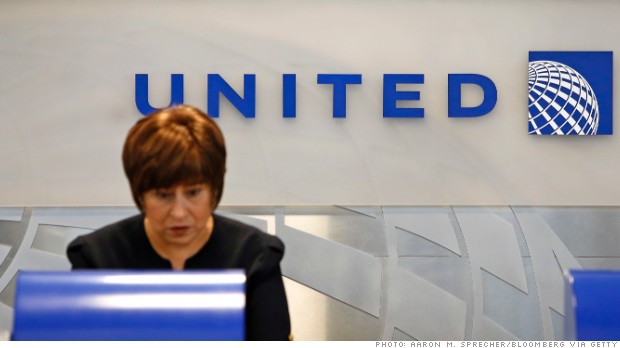
United mistakenly offers free fares

united free ticket
Passengers on United's site were able to book tickets for a time for only the cost of the airport and security fees. So travelers were able to get flights for $5 or $10.
NEW YORK (CNNMoney)

United Airlines briefly, and mistakenly, offered passengers the ultimate fare sale on Thursday -- $0 fares.

The passengers on United's web site were able to book tickets for a time for only the cost of the airport and security fees tacked onto tickets. So travelers were able to get flights for between $5 and $10.
One customer posting on the passenger Web site flyertalk.com bragged about bagging a $10 round trip between San Jose and Boston -- a ticket that might normally cost $600.
(Related: Bankrupt airline posts record profit)
United confirmed the mistake but declined to comment on the details of the outage or whether it intends to honor the tickets.
"One of our filings Thursday contained an error which resulted in certain fares being displayed as zero. We have corrected this error," the airline said in a statement. It added that the mistake was made by a person and was not the result of a technology glitch.
Rick Seaney, chief executive of Farecompare.com, said the problem lasted about two hours.
"People were buying tickets all over the place," said Seany. "Guys were buying 12 and 15 of these things from Washington DC and Honolulu. The question is will they honor them?"
-- CNNMoney's Aaron Smith contributed reporting. To top of page
Friday, September 13, 2013 - By Unknown 0

Thursday, September 12, 2013

Top Lawmakers Pile On Putin Op-Ed: ‘Almost Wanted to Vomit’, ‘An Insult’

gty bob menendez kb 130912 16x9 608 Top Lawmakers Pile On Putin Op Ed: Almost Wanted to Vomit, An InsultTop Democrats and Republicans in Congress scrambled to respond to Russian President’s Vladimir Putin’s Op-Ed in The New York Times on Thursday — and the reviews were less-than-glowing.
Sen. Bob Menendez, D-N.J., was first out of the gate: “I almost wanted to vomit,” Menendez, chairman of the Senate Foreign Relations Committee, said on CNN Wednesday evening.
“I worry when someone who came up through the KGB tells us what is in our national interests, and what is not. It really raises the question of how serious the Russian proposal is.”
Putin’s Op-Ed Says Strike Would Unleash New Terrorism
Putin denied protecting the Syrian government, writing, “it is alarming that military intervention in internal conflicts in foreign countries has become commonplace for the United States.”
During a news conference Thursday, House Speaker John Boehner said, “I was insulted,” when he read Putin’s editorial.
Senate Majority Leader Harry Reid said he didn’t think Putin was trying to undermine the president on Syria with his op-ed but was instead “looking for an excuse to show off his Super Bowl ring.”
Sen. John McCain, R-Ariz., in a tweet, called Putin’s words “an insult”: “Putin’s NYT op-ed is an insult to the intelligence of every American.”
Sen. James M. Inhofe, R-Okla.,  said in an interview with CNN on Thursday that he too was not a fan of Putin’s piece: “I could hear Reagan turning over in his grave.”
These critical comments by key lawmakers reflect the growing skepticism over the veracity of Russia’s diplomatic proposal, which is spreading on Capitol Hill.
Sen. John Cornyn, R-Texas, an opponent of the use of military force in Syria, said on the Senate floor Wednesday, “I would caution all of us – the American people and all of our colleagues – to be skeptical for good reason at this lifeline that Vladimir Putin has now thrown the administration.”
“We have very little reason to believe that Moscow is a reliable diplomatic partner. They are part of the problem in Syria, not part of the solution.”
Congress has decided to postpone voting on the use of force against Syria while President Obama works on a diplomatic solution with Russia. But Senate Majority Leader Harry Reid warned Syria and Russia that the U.S. Congress would keep a watchful eye on the negotiation process to see whether the countries are being truthful or not.
“Leaders in Damascus and Moscow should understand that Congress will be watching these negotiations very closely,” the Nevada Democrat said Wednesday. “If there is any indication these are not serious, that it’s a ploy to delay, to obstruct, to divert, then I think we have to again give the president the authority to hold the Assad regime accountable.”
Thursday, September 12, 2013 - By Unknown 0

Prominent US jihadist ‘killed in Somalia’


REUTERS
Omar Hammami addresses al-Shabaab fighters in a farm within Afgoye district near Somalia's capital Mogadishu in 2011.
Mogadishu - A prominent US-born Islamist militant was killed in Somalia on Thursday after he fell out with senior commanders of the al Shabaab rebel group, witnesses said.
Residents in al Baate village in southern Somalia said Alabama-born Omar Hammami, commonly known as Abu Mansoor al-Amriki or 'the American', and a British national known as Usama al-Britani were shot dead in a dawn raid on their hideout.
iol pic afr al Baate village-omar hammamiHammami's killing exposed widening rifts in al Shabaab's top ranks as the group affiliated to al-Qaeda grapples with an African Union-led military offensive that has captured key cities from the militants, depriving them of revenues.
“This morning al-Amriki and his comrades were attacked by well armed fighters,” said village resident Hussein Nur. “After a brief fight al-Amriki and his two colleagues were killed. Several of their guards escaped.”
A second villager confirmed the gun battle and said he had heard al Shabaab fighters confirm the deaths, though he had not seen the bodies.
“No-one is allowed to go near the scene,” the shopkeeper told Reuters by telephone from the village that is under militant control.
Hammami is believed to have arrived in Somalia aged 22 in late 2006, shortly before a US-backed Ethiopian military incursion into the war-shattered Horn of Africa country to rout an Islamist administration that had dislodged the government.
Fluent in Somali, Hammami swiftly became an influential leader of al Shabaab's foreign jihadists fighting to topple a government seen as a Western puppet and impose a strict interpretation of sharia law on Somalia.
Al Shabaab announced a formal alliance with al-Qaeda in February 2012. Hammami was added to the US Federal Bureau of Investigation's Most Wanted Terror list in November that year and a $5 million bounty was offered for information leading to his capture. - Reuters
Thursday, September 12, 2013 - By Unknown 0

Syria Is a Legal Triumph

If a deal holds up, it will be a tremendous victory for international law, despite Obama’s bungling.U.S. President Barack Obama

President Obama has bungled Syria. He said he’d enforce the accidental red line he drew on chemical weapons, then tacked to asking Congress for approval for military strikes, then swerved again to nudge the Russians to broker an unlikely deal with Assad. The zigzagging made his big speech Tuesday night confusing and unconvincing.
And yet, all of this looks pretty good at the moment if you’re tracking not Obama’s credibility or political skillsbut the rule of law. Of course it could all fall apart, but right now international and constitutional law are looking stronger than they did before the president got himself into his red-line mess.
There are two competing norms of international law at stake in the world’s response to the Syrian gassing: The ban on chemical weapons and the post-World War II system for maintaining relative peace around the globe—the 1945 U.N. Charter. The two norms are directly clashing at the moment. Syria never signed onto the Chemical Weapons Convention, in force since 1993. And the U.N. Charter requires the Security Council to approve the use of force Obama has planned—approval that Russia and China, which have veto power, won’t give. And so the big clash on the left is over which to value more: preventing the use of chemical weapons or maintaining the U.N. system that limits the legal use of force more broadly.
Advertisement

The pro-intervention argument, made forcefully by Obama’s U.N. ambassador, Samantha Power, values enforcing the chemical weapons ban over respecting the procedures by which the U.N. operates. If the Russians are holding the Security Council “hostage,” as Power says, then the U.S. gets to opt out. The contrary, not-so-fast argument, captured by Yale law professors Oona Hathaway and Scott Shapiro, is that all of our breaches of U.N. rules “add up — and each one makes it harder to hold others to the rules. If we follow Kosovo and Iraq with Syria, it will be difficult, if not impossible, to stop others from a similar use of force down the line.” Hathaway and Shapiro are reminding the country that opting out of the U.N. rules isn’t free, no matter how worthy the humanitarian rationale. They want Obama to think about whether punishing Assad’s use of chemical weapons “is worth endangering the fragile international order that is World War II’s most significant legacy.”

The president seemed inclined to brush by this question. But the country, plus our reluctant allies—thank you, Britain—wouldn’t let him. The continuing lack of support at home and abroad for striking Syria forced Obama to say he would go to Congress. And that’s a victory for another kind of rule of law: The Constitution’s war-making powers. Presidents have taken more and more of this authority, either because they’ve usurped it or because Congress has handed it over. Obama did his own grabbing when he intervened in Libya without going to Congress first. The War Powers Act—the congressional answer to Vietnam—should have stopped him. It didn’t.
But Obama declined to take presidential power that one more step. Without NATO, or decent poll numbers to back him up, Obama decided he had to have Congress behind him. This isn’t the most high-minded way to get there, but I’ll take it. Score one for limiting executive power as the Constitution calls for.

Skeptics, among them Slate columnist Eric Posner, point out that Obama keeps saying he retains the power to strike Syria even if Congress votes against him. And so he’s aggrandizing rather than humbling his office. Another problem is that the legal rationale the administration is floating—that the president can bomb another nation, on his own, based on his own decision that an "important national interest" is at risk—is crazy broad. It sounds like anything goes, who needs Congress, unless American troops are going in on the ground.
But as long as Obama doesn’t actually strike Syria if Congress won’t authorize it—and isn’t that becoming unimaginable?—these excesses are like the bad night of drinking that doesn’t end in actual injury.

I do see an obvious pitfall here: Future presidents could run away from Congress based on the Obama experience. Don't take anything to Congress because it's a huge mess! But hang on. What if this all ends better than it began—what if the Russians get more from Assad than bombs would have? Yes I know that securing Syria’s chemical weapons will be enormously difficult, practically speaking. But think about it: Syria just admitted for the first time that it has chemical weapons and announced that it wants to sign on to the treaty that bans them. Russia is pressuring Assad to do something good rather than standing by and letting him do evil. If any kind of deal can be cobbled together, it will be a net gain. Obama will be right that it would never have happened without the credible threat of the use of force. And at the same time, as long as the threat doesn’t materialize, it won’t erode the international system of law or the Constitution’s division of powers either. Given how very badly this could have gone for both—and could still go—that sounds like victory to me.
Thursday, September 12, 2013 - By Unknown 0

Powered by Blogger.

Popular Posts

Recent news

Discussion

© 2014 NEWS FOR LIFE....... Distributed By MyBloggerThemes | Design By Bloggertheme9
Powered By Blogger.
back to top